Quick links to topics

Showing posts with label review. Show all posts

In Her Majesty's Name - a review

Yesterday I received my pre-order copy of "In Her Majesty's Name".

 Like a bounder I tagged my order on to the shirt tails of those that had blazed their way through the fund raiser when there were only hours left before the fund raiser closed.

 I would have loved to have spent a bit more to secure some of the figures, but there were out of my budget. I didn't want the figure packs on offer, rather the never to be sold figures only for those funding the project with higher payments could get.

Contenting myself with just the rule book I waited with anticipation for it to arrive.

 Enough of my waffle - on to the review.


In Her Majesty's Name

 The book is the same size of the Osprey Men at Arms series, so most readers will be familiar with the dimensions.
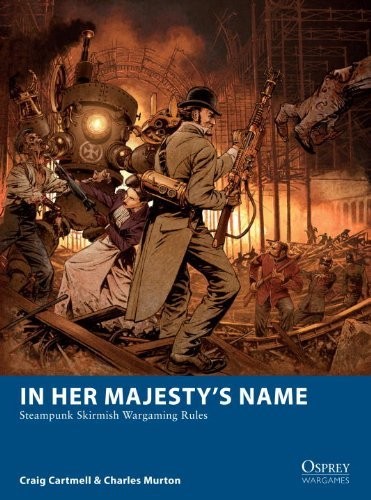

In total there are sixty four pages in the book, including contents and reference sheets.

The way the rules are laid out is a bit similar to some military publications, in that each section has a 'chapter' number, and each sub section is also numbered. Thus section one is divided into "1", "1.1", "1.2" and so on.

 As you read through the rules any reference to another rule within an explanation also gives the numbered reference to the other rule as part of that explanation.

For example 3.2.2 Running mentions figures in certain armour types can not run. This sentence also has a reference number to the armour types mentioned by including (5.1) within the rule.

 This makes it very easy to follow the logical progress of the rule and quickly find the following up section to fully understand the rule in question.

The rules are broken down into easy to read and understand sections.

 The introduction includes standard information such as standard gaming conventions describing dice rolls and what you need to play.

 Next comes a description of attributes for each figure within the game.  As the game is not stat heavy this is far from taxing on the brain.

Following that is the core rule system itself, covering movement, shooting and melee.

The remainder of the book covers setting up a game, charts listing all the equipment stats for the game, pre-generated groups of adventurers (referred to as "companies' within the rules... not a business type company, but a band of fellow like minded chaps), scenarios, settings for your games and then the briefest of campaign notes.

As mentioned the rules are very easy to read and understand.  Even though they might appear simple there is plenty of scope for tactics and rewarding clever thinking whilst playing a game.

One really good thing about this game is that each player doesn't need a lot of figures to play a game (between five and twenty figures per side is suggested) and a 3' x 3' playing area (that is roughly 91.5 centimetres for us metric types).

 Designing your companies does have a point value system to prevent players from going potty and fielding 100 steam tanks against five newspaper boys but, unless you are playing against a complete bounder, gentlemen could dispense with the need for the use of points should they be so inclined.  I for one will keep to the point value system, and I am one that normally hates points values.

Within the rules are notes for designing your own armour, weapons and mystic powers. This allows for players to add new aspects to the game.

 What there isn't is a system for designing your own 'weird science' (read steam powered vehicles, weapons of confounded design or simple gadgets).  Hopefully this will come out with the second book planned for the game, or failing that, a third book.

The campaign rules are very brief, but not hard to flesh out should a player feel the need to do so. Within the campaign rules is a system for advancing your intrepid heroes or adding new equipment or adventurers to your company should you feel the need.

 Over all  I think these are a great set of rules with enough flavour to capture the feel of Victorian Science Fiction / Steampunk.

And I think they will work nicely for a play by blog game... but not until I have finished the planned zombie game.

So, if you like VFS / Steampunk or are interested in it, I highly recommend the rules to anyone still wondering if they want to get them or not.

Now to order the figures I need for my first game.......

AirWar: C21 - review after game played

I just finished playing a test game of AirWar: C21, and it was very enjoyable.

 I randomly rolled for all pilot skill levels that gave me three average pilots and one green pilot.

 I pitted my F-15s against the Su-27s, with the only green pilot being in an Su-27.

As I was playing the game solo, I used the manoeuvre cards I created as hidden movement - a card was chosen at random and placed next to the enemy plane, with only certain manoeuvres beings allowed if fired upon. This was done to reflect a pilot taking an evasive move when targeted.

 Each turn I wrote down the orders for my F-15 pilots before placing enemy movement cards.

 I then rolled for initiative for all the planes and played out the phase in order.

Initially the game was slowed by having to re-read rule sections and to make sure I was doing the correct things, but after a few game turns I was using the QRS more than the book, with the exception of expanding on information that was on the QFS.

My pilot reference sheets proved to be essential as this had all the data I needed at hand, which means the game flowed a lot faster.


 During the game I realised I needed missile counters, so I borrowed an idea I found on the web and cut sections of pipe cleaners and up them on flight stands. This worked very well indeed, and I used the idea for missiles and chaff/flares.

 Due to the small playing area I had, I used centimetres instead of inches, and this worked perfectly.

In the first game turn my #2 F-15 failed his manoeuvre, but it was lucky for him that he was out of range of any enemy fire. All other planes moved without hassle.

 In the second turn F-15 #1 increased its speed in order to get into missile range, and his intended target failed its manoeuvre - presenting a nice target for the AIM-7s.  One of the fired missiles missed, but the second one did enough damage that the Su-27 blew apart.


In the third turn the remaining Su-27 fired two missiles at the victorious F-15, and in turn both F-15s fired missiles at the Su-27.

 Bad dice rolls saved the targeted F-15, but I am putting the misses down to the chaff used.

The Targeted Su-27 evaded two of the four missiles. The third missile struck the plane causing a lot of damage, but not destroying it. That job was left to the fourth missile, which destroyed the Su-27 in a massive fire ball.

 The game didn't take long to play at all - with only four planes in total the game moved very fast. I except with more planes the game would slow down, but once the rules are understood and I know what is what, that time would be cut down.

 I enjoyed the game, and will definitely be playing more games in the future.

When I next go shopping I will buy some different pipe cleaners and make some better missile and chaff counters with them.

Having played the game I am happy that I can play it solo, and with this in mind I will be purchasing more aircraft for each side with the intention of playing a campaign.

AirWar: C21 a first impressions review

My AirWar: C21 rules arrived this week after a bit of a delay from the U.K. end.

I ordered 2 x F-15s and 2 x Su-27s and magnets with the rules so that I could use them in a game ASAP.

 And have your anginine handy -  I have already painted the minis!

 The planes are Tumbling dice 1/600 scale miniatures and they are great. I didn't paint up any fancy or complicated paint schemes for them as I want to use them for many different nations as my scenarios require. Thus I won't be painting any markings on the planes.

F-15s and Su-27s - not very imaginative paint jobs I know.


Anyway, a quick review of the rules, bearing in mind that I have yet to play a game and that I have only read them a few times.

 I ordered the book, but you can easily pay for and download a PDF and print them out yourself.

 The rules are 44 pages long, including contents and quick reference sheets.

 Most of the book is taken up with plane and weapon data, with the actual rules taking up 14 pages, with an extra 10 pages dedicated to air to ground rules.

 At first glance the rules can be a bit daunting as there are a few stats to take in, but once you read the rules and check what the rules discuss against the plane and missile data it all makes sense and isn't really that complicated at all.

 Playing a game requires d6 and d10 dice and your playing surface. A hex sheet is not needed in any way at all, but if you can't cope without one you could easily adapt the rules to allow for hex movement.

 Also there is no altitude system with the game so you don't have to record what altitude your planes are flying at which helps speed things up a bit.

 Each turn is broken down into two phases which are almost identical in what you do in them.

 Players select their speed, their manoeuvres, roll for initiative and spotting. Based on the initiative the planes are then moved, combat is conducted and then final speed calculated based on damage or manoeuvres made.

Pros and Cons

  •  Pros 

    you can play a game from anytime 1960 on wards, which gives a lot of scope for different historical wars as well as some non-historical ones.
 While designed for two or more players I honestly think it would be easy to play solo by the use of manoeuvre cards.


  • Cons 

   the game doesn't come with manoeuvre cards, roster sheets or any markers the game requires you to have to play the game. Fortunately I was able to find some roster sheets and manoeuvre cards in a yahoo group.

 The rules mention campaign games, but doesn't have any campaign rules. As I love campaigns this was a bit of a bummer for me, but I will probably adapt an old board game I have called "Hornet Leader" for use with the game, or even make my own system.

 The rules have Pilot skill ratings from Green to Ace (5 skill levels in all) but doesn't tell you how to generate pilots for your games. Again I will come up with something for this.

~                                   ~                            ~

Overall the rules seem quite good, but I will reserve my full judgement until I have played a game. I will post my thoughts on how the game played once I have done so.

Strange Aeons - review

I was asked to do a review on Strange Aeons, so here goes:


Strange Aeons is a wargame that pits 1920's agents against eldritch horrors. Whilst not actually set in the Call of Cthulhu universe, it does draw heavily on that background, with some of the same monsters included, and some included with different names.


 The Agents are known as "Threshold" with the horrors known as "Lurkers". The background for the rules has a strong US flavor to the game but it can be set anywhere. For my games I have used the UK as my background.


The playing area for the game is small, 2 feet x 3 feet is suggested, and scenery is only limited to your imagination.


 Each player takes control of 1 - 10 figures each and 25/28mm is the scale of choice for the game, but I have seen 15mm and even 10mm games on LAF. I prefer 25/28mm due to the sheer number of figures on the market: Pulp Miniatures, RAFM, Artizan Designs, EM4 and Uncle Mike's Worldwide to name but a few.


 Dice for the game are d6, with the occassional need for a d3; but that is just a d6 halved.


 All measurements in the game are done in inches, but if you are one of those that can't or wont use inches, then converting is easy.


Each agent/horror has a set of stats that reflect movement, the ability to attack and how sane they are. There are six stats in all.


 Skills are included in the rules - agents/humans (cultists) get to choose which skills they have, with most monsters having skills listed already, and in some cases monsters can be given extra skills.


Once the Threshold Player has created his team (up to a maximum of 15 points... this number can go higher, but only through winning games) a scenario is chosen and the Lurker player puts together his force.
 Each game for the Threshold player uses the same agents, where as the Lurker can change his forces each game. This is because the Agents are the main focus of the game.


 With the scenario chosen figures picked and scenery placed the game can now begin. 


 The initiative for the game is determined by the scenrio, and players take it in turn to choose a figure and give it up to two orders. Command figures can activate two other figures from the same side  at the same time if within command range.  This sequence continues until all figures have been moved.


 Combat: 
              melee - both sides roll a number of dice indicated by the stats of the combatants. Dice cancel out each other, and the one with the most hits not cancelled out wins.
             Shooting - attacker rolls dice vs target's dex stat.


 Most cultists will be taken out with one hit (which is why there are a lot more of them in the game) whereas agents and monsters take a few more hits before they are removed from play.


 At first read the system for building your team of figures and combat can seem a little confusing, but going through it a few time and reading posts of LAF soon clarify any confusion.


 For example - when building your team (either Threshold or Lurker) you have Build Points and Base Points - both are abbreviated to 'BP'.  This seems to throw most players at least once.


 There is a Quick Reference sheet at the back of the rules, but it doesn't contain every thing you might like to know, so making one helps a lot. But there again, many rules suffer from this.


 This game is a lot of fun and doesn't break the bank when you start buying figures.


 The game doesn't have solo rules, but I created my own solo system that has even drawn  positive comments from the game's designer.


Strange Aeons quickly became one of my favorite games and I have had a lot of fun coming up with the background story for my campaign as well as making some scenery.


 Apart from the initial confusion with the rules (and a lot of people seem to suffer this one) the only other bad point I have is that where is no system for creating your own monsters and giving them a BP rating. I have created my own lurker monsters, but have no idea of the BP I should give them.


 Strange Aeons is quickly gathering a bit of a cult following in the wargaming world especially amongst Call of Cthulhu fans.